
By A1 Cash for Cars Team · Last updated: 20 November 2026
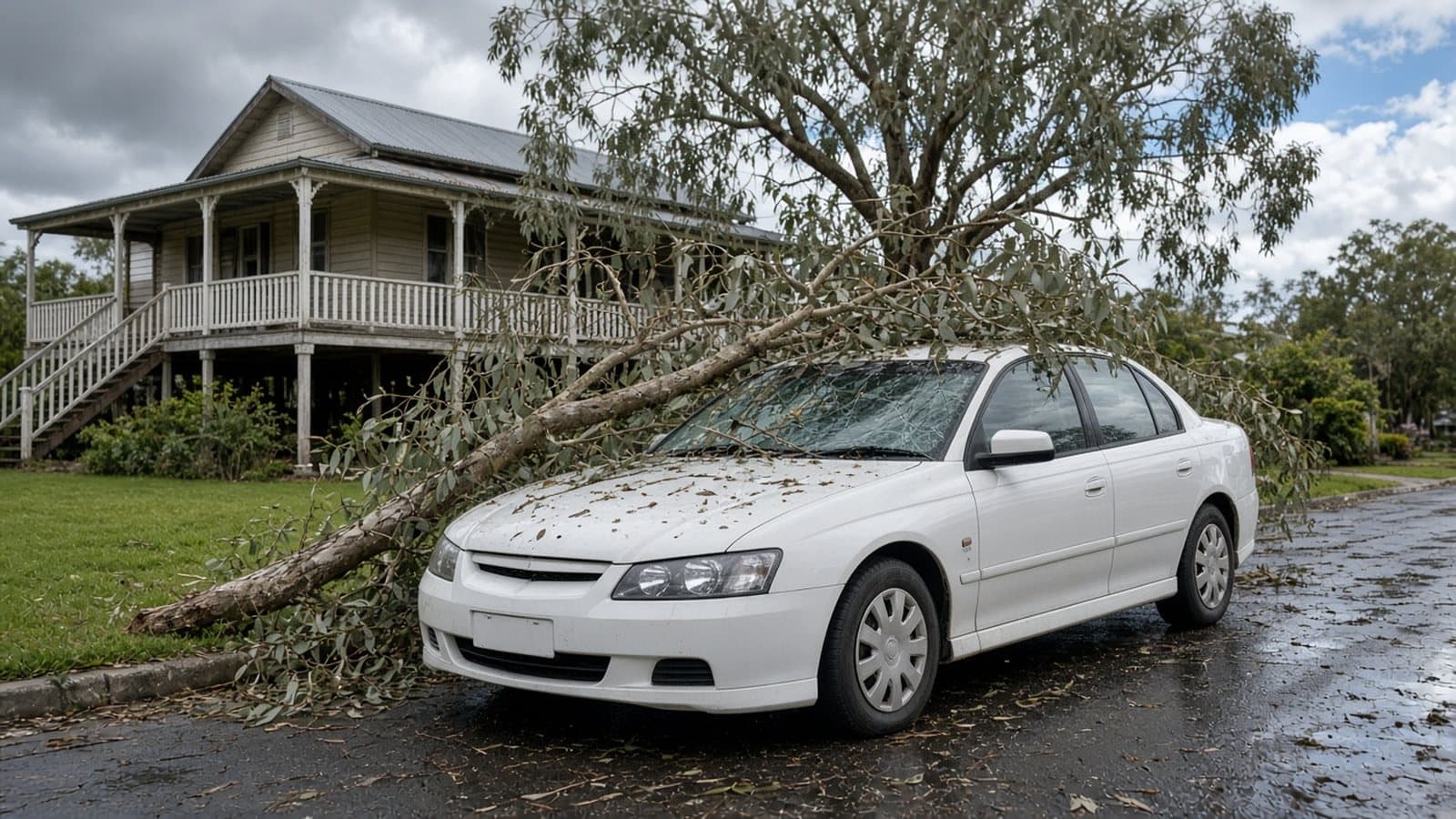
A1 Cash for Cars is a licensed motor dealer with a yard at 60 Bowhill Rd, Willawong. We assess and buy unwanted, damaged, unregistered, scrap and non-running cars, utes, vans and 4WDs across Greater Brisbane, including cars hit by fallen trees and branches, wind-blown debris and collapsed carports during storm season.
Yes, you can sell a storm-damaged car in QLD, but safety comes first, and if the car is insured you should talk to your insurer before you sell. This guide covers fallen trees and branches, wind-blown debris, carport collapses, smashed glass and power lines, plus insurance claims, write-offs, repair-or-sell decisions and the paperwork. For hail or floodwater damage, see our guides to selling a hail-damaged car in Brisbane and selling a flood-damaged car in QLD.
Key takeaways
- Stay well clear of fallen power lines. Energex says to stay at least 10 metres away, assume fallen powerlines are live, and call Triple Zero (000) or 13 19 62. (Energex)
- Photograph the damage and call your insurer early. The Insurance Council of Australia says to contact your insurer as soon as possible and take photos or video before you clean up. (Insurance Council of Australia)
- Only some policies cover storm damage to your own car. Comprehensive cover includes weather events; third party property damage doesn’t cover your car at all. (Moneysmart)
- A weather event can make a car a write-off. Queensland lists a weather event as one way a car can become a total economic loss, and write-off status is permanent and shows on a PPSR search. (Queensland Government)
- No safety certificate when you sell to a licensed dealer. Vehicles that are unregistered, or traded to licensed motor dealers, don’t need one. (Queensland Government)
Can you sell a storm-damaged car in QLD?
Yes. No Queensland rule stops you selling a car damaged in a storm, but the right path depends on the damage and who owns the car after any claim. If an insurer is paying out, check with them first. Otherwise, you can repair it, sell it unregistered, or sell it as is to a licensed motor dealer.
Storm season matters here. The Queensland Government says storm season typically runs from November to April, and severe storms can bring strong winds, heavy rain, lightning and hail, damaging homes and vehicles (Queensland Government, DETSI). Queensland’s selling a used vehicle page says the easiest way to sell is to a licensed motor dealer, and that if a registered car is “in an unsafe condition or otherwise defective” you can repair it, sell it to a dealer, sell it to a dismantler or sell it unregistered.
| Selling option | Safety certificate needed? | Best suited to |
|---|---|---|
| Private sale, registered | Yes, a current one | Cars with minor storm damage that has been fully repaired and will pass inspection |
| Private sale, unregistered | No, but the car can’t be driven on the road without a permit | Buyers who want to repair a damaged car themselves |
| Licensed motor dealer | No | Cars with broken glass, crushed panels, water inside or other storm damage, written-off cars, or a quick sale |
| Auto parts dismantler | No | Badly crushed cars worth more as parts or scrap metal |
Sources: Selling a used vehicle and Safety certificates, Queensland Government. The safety certificate page also says vehicles can still be sold for parts, but they must be de-registered before being sold.
What kind of storm damage does your car have?
Storm damage ranges from a few dents and a cracked windscreen through to a car crushed by a tree or a collapsed carport. Broken glass can also let rain into the cabin, adding water damage to the list. The type and extent of the damage decides whether the car is easily repaired, a write-off or only good for parts.
RACQ warns that falling branches can cause significant damage to body panels, windscreens and roofs, which is why it advises against parking under trees in storms and strong winds (RACQ).
| Type of storm damage | What it usually looks like | What it often means for a sale |
|---|---|---|
| Fallen branch | Dented bonnet, roof or boot, cracked windscreen, scratched paint | Often repairable, but roof and pillar damage can be expensive |
| Whole tree on the car | Crushed roof, pillars or cabin, smashed glass, bent body | Often a total loss, especially if the roof and pillars are crushed |
| Wind-blown debris (sheeting, fencing, outdoor furniture, bins) | Dents, scratches, broken lights, mirrors or glass | Usually repairable, depending on how many panels are damaged |
| Carport, roof or garage collapse | Roof and bonnet damage, broken glass, damage on several sides | Ranges from repairable to a write-off |
| Smashed glass with rain getting inside | Wet carpet and seats, damp smells, electrical faults | Water can damage wiring and electronics, so don’t start it until it’s checked |
| Contact with fallen power lines | Car sitting under or touching a line or pole | Stay away; Energex must make it safe before anyone goes near the car |
| Hail or floodwater | Dimpled panels, or water through the cabin and engine | See our hail and flood guides |
If the only damage is broken glass, our guide to selling a car with a cracked windscreen in QLD explains the rules for windscreen damage.
What should you do first after a storm damages your car?
Make sure everyone is safe, stay well away from any fallen power lines, and don’t start the car if water has got inside. Once it’s safe, take photos and video of the damage before anything is moved or cleaned up, then contact your insurer. If a tree is blocking access or damaging your home, the SES can help.
Energex’s advice is clear: always assume fallen powerlines are live, stay at least 10 metres away, warn others and call Triple Zero (000) or 13 19 62, then wait for Energex to make the area safe. It also warns that fallen powerlines can be hidden by debris and hard to spot (Energex). The Get Ready Queensland and SES Severe Weather Safety Guide adds to be careful of metal objects that may be in contact with downed power lines, and to take photos of any damage and contact your insurer.
- Don’t try to drag a branch off the car yourself if it’s large, under tension or anywhere near a power line.
- Don’t start the car if water got inside. RACQ says if there has been any water in the interior, engine bay or exhaust, don’t start or drive it (RACQ).
- Photograph everything first. Take wide shots of where the car is and what hit it, then close-ups of each damaged area, inside and out.
- Remove personal items such as toll tags and garage remotes, as RACQ suggests, if you can reach them safely.
| Situation | Who to contact | Why it matters |
|---|---|---|
| Anyone injured or in danger | Triple Zero (000) | Life-threatening emergencies come first |
| Power line down on or near the car | 000 or Energex on 13 19 62 | Only Energex can make the area safe; stay at least 10 metres away |
| Tree blocking access or damaging your home | SES on 132 500, the SES Assistance QLD app or 132500.qld.gov.au | The SES can do temporary work, including fallen trees blocking access |
| Council street or park tree fallen on the street | Brisbane City Council (or your local council) | Council handles its own street and park trees, not trees on private property |
| Car damaged and you have car insurance | Your insurer | They’ll explain the claim, towing and assessment |
Sources: Report fallen powerlines, Energex; Severe Weather Safety Guide, Get Ready Queensland and Queensland SES; Report tree maintenance issues, Brisbane City Council.
The SES guide notes that demand on the SES during severe weather is huge, so help may take hours or even days, and that permanent repairs are arranged through your insurer or a private contractor. Brisbane City Council says not to use its tree form for a tree that has fallen on a powerline; phone Energex on 13 19 62 instead.
Does car insurance cover storm damage?
Only if your policy covers damage to your own car from weather events, which usually means comprehensive cover. Moneysmart says comprehensive insurance covers your car if it’s damaged by weather events, while third party property damage doesn’t cover your car at all. Every policy has exclusions, so read your Product Disclosure Statement before you decide anything.
Moneysmart’s choosing car insurance page even lists storm damage as an example of an exclusion to compare between policies. Queensland insurers RACQ and Suncorp both list storm among the events their comprehensive policies cover (RACQ, Suncorp).
| Type of cover | Storm damage to your own car? | Points to know |
|---|---|---|
| Compulsory Third Party (CTP) | No | Covers injuries to people caused by your car, not damage to cars or property |
| Third party property damage | No | Covers damage your car causes to other people’s cars or property |
| Third party property damage, fire and theft | No, only fire and theft | Adds cover if your car is stolen or damaged by fire |
| Comprehensive | Usually yes | Covers weather events, subject to the policy’s exclusions, excess and limits |
Source: Choosing car insurance, Moneysmart (ASIC).
What if the tree belonged to a neighbour or the council? It’s natural to ask whether the tree’s owner should pay. Financial Rights Legal Centre explains that if a healthy tree falls in a storm, its owner is usually not liable because it’s treated as an “act of God”, although the owner may be liable if they knew the tree was dangerous. In its example, a tree falls on a car parked in the street, and the owner claims on their own comprehensive car insurance (Financial Rights Legal Centre). Liability depends on the facts, so ask your insurer or get legal advice if you think someone else is responsible.
When you lodge a claim, insurers usually ask for details of the incident and the damage, plus photos if you have them. AAMI, for example, says the damage is assessed and, if the vehicle is assessed as a total loss, it will contact you to discuss what happens next (AAMI). The Insurance Council of Australia adds that if you’re in urgent financial need, you can ask your insurer to fast-track your claim and make an advance payment (Insurance Council of Australia).
Will your insurer write off a storm-damaged car?
Sometimes. Queensland treats a car as a total economic loss when its pre-damage market value is lower than the repair cost plus the wreck’s salvage value, and a weather event is one of the listed causes. A few dents usually won’t write a car off, but a crushed roof, many damaged panels or water inside can.
Whether the car is written off depends on your insurer’s assessment and your policy. AAMI, for example, says a car becomes a total loss if it’s uneconomical or unsafe to repair, including where the combined repair costs and salvage value are likely to be more than the amount covered by the policy (AAMI).
If a notifiable vehicle is a total loss, the notifier (usually the insurer’s assessor) must assess it as a statutory or repairable write-off using standardised damage criteria and report it to Transport and Main Roads (TMR).
| Statutory write-off | Repairable write-off | |
|---|---|---|
| Can it be re-registered? | No, never in Australia | Yes, after a safety certificate inspection and a written-off vehicle inspection (WOVI) |
| What it can be used for | Parts or scrap metal only, with restrictions on some parts | Repair and re-registration, or parts |
| Restricted parts | Parts that record the VIN or chassis number, the chassis on body-on-frame vehicles, and some airbags, including those from water-damaged vehicles | Not applicable |
| Recorded on the register and PPSR? | Yes, permanently | Yes, permanently |
Source: How the Written-off Vehicle Scheme works, Queensland Government.
Two Queensland rules are worth knowing. Only “notifiable vehicles” are written off in Queensland: light vehicles registered in Queensland, or unregistered and located here, that are 16 years old or younger when they become a total loss. An older car an insurer calls a write-off isn’t recorded on the register, but defective vehicles must still be repaired to a roadworthy condition before they’re used on the road. And if no insurer or other notifier has reported a notifiable total loss, the owner must notify TMR with form F4069 before selling or disposing of it (Queensland Government).
Before you sell an insured storm-damaged car, ask your insurer three questions: is it a total loss, is it a statutory or repairable write-off, and who will own the wreck once the claim is settled? If the insurer has paid out the car as a total loss and taken ownership, the car belongs to the insurer, and it’s not yours to sell. If you choose to keep a written-off car, it stays recorded on the register. Our guide to written-off cars and insurance total losses in QLD explains payouts, keeping the wreck and disputes in more detail.
Should you repair or sell a storm-damaged car?
It depends on the repair cost compared with what the car will be worth afterwards, your insurance position and how much you rely on the car. A newer car with a dented bonnet and a cracked windscreen is often worth repairing. An older car with a crushed roof or wet interior may cost more to fix than it’s worth.
| Factor | Points towards repairing | Points towards selling as is |
|---|---|---|
| Insurance | Comprehensive claim accepted and the car is assessed as repairable | No cover for storm damage, or the excess and repair cost outweigh the benefit |
| Extent of damage | One or two panels, glass, lights or mirrors | Roof, pillars or structure crushed, or damage on several sides |
| Water inside | None, or quickly dried with no electrical faults | Wet carpets, damp smells, warning lights or electrical faults |
| Age and value | Newer car with good value before the storm | Older car where repairs approach or exceed its value |
| Write-off status | Not written off | Statutory write-off, or a repairable write-off you don’t want to rebuild |
| Your plans | You want to keep the car for years | You were already thinking about replacing it |
Get a written repair quote before deciding, and ask the repairer to check for hidden damage, such as bent mounts, water in wiring or damaged sensors behind the bumper. Our guide to whether to repair or sell your broken car in Brisbane walks through the trade-offs, and our guide to selling an accident-damaged car in QLD covers panel and structural damage in more depth.
Do you need a safety certificate to sell a storm-damaged car?
Only for a private sale of a registered car. A car with broken glass, crushed panels or storm-damaged lights is unlikely to pass inspection without repairs, so many owners sell it unregistered or to a licensed motor dealer instead. Queensland says vehicles that are unregistered, or traded to licensed motor dealers, don’t need a safety certificate.
The Queensland Government warns you can be fined over $700 for not having a current safety certificate when disposing of a registered vehicle other than to a dealer (Queensland Government). A1 Cash for Cars is a licensed motor dealer, so you don’t need to get one before selling the car to us. Our safety certificate guide explains the rules in full.
A repairable write-off needs both a safety certificate inspection and a written-off vehicle inspection to go back on the road. If you’re selling a storm-damaged car privately, be upfront about the damage and any write-off status. Queensland’s notify page says dealers and auctioneers must tell buyers about write-off status, and a PPSR search will show it anyway (Queensland Government). Our guide to disclosing faults when selling a car in QLD explains why honesty protects you.
What paperwork do you need to sell a storm-damaged car in QLD?
You need proof of identity, proof you own the car, and the right registration step: transfer the registration to the buyer, or cancel it if the car is being sold for parts or has been written off. If finance is owing, the lender must be paid out or agree before the sale, and a PPSR search shows any security interest.
| Paperwork step | What to do | Source |
|---|---|---|
| Registration transfer | Transfer the registration out of your name using Part B of form F3520 or online; the buyer must transfer it within 14 days | Queensland Government |
| Cancelling the registration | Complete form F3517; check with your insurer first, as they may handle the write-off and cancellation | Queensland Government |
| Number plates | Hand in both plates when you cancel; if a plate was lost or destroyed in the storm, declare it in Section 7 of the form | Queensland Government |
| Write-off notification | If no insurer or notifier has reported a notifiable total loss, lodge form F4069 when you cancel the registration | Queensland Government |
| Finance owing | Get a payout figure from your lender; a security interest shows on a PPSR search | Queensland Government (Office of Fair Trading), PPSR |
| Insurer ownership | If the insurer has settled the claim and owns the car, it’s the insurer’s to sell | Your insurer |
Sources: Transfer registration as a seller, Cancelling your vehicle registration, Notifying of written-off vehicles and Clear title or free from debt, Queensland Government; Do a used car or vehicle search, PPSR.
TMR says there’s no cost for the seller to transfer a registration out of their name; the buyer pays the transfer fee and duty. If the buyer doesn’t complete the transfer within 14 days, TMR says you should lodge Part B yourself or transfer the registration online. The PPSR notes that a security interest means the car could have money owing on it, but a search won’t tell you how much. These guides cover each step in detail:
- Transferring registration after selling a car in QLD
- Cancelling car registration and getting a refund in QLD
- What to do with number plates when selling a car in QLD
- Selling a car with finance owing in QLD
- PPSR checks when selling a car in QLD
- Paperwork you need to sell a car in QLD
How do you sell a storm-damaged car to A1 Cash for Cars?
Call or request a quote with the car’s details, describe what hit it and where it’s damaged, and tell us about any insurance claim. As a licensed motor dealer, we don’t need a safety certificate from you. Damaged and written-off cars can often be collected, subject to ownership, the insurer’s status and safe access.
- Gather the details. Year, make, model, VIN, kilometres, registration status, where it’s parked and any finance owing.
- Describe the storm damage. What hit the car, which panels and glass are damaged, whether water got inside, and whether it starts. Send photos if you can take them safely.
- Share your insurance position. Whether a claim has been lodged, whether the car has been written off as statutory or repairable, and who owns it now.
- Get an assessment. We look at the whole car, not just the storm damage.
- Arrange collection. Collection depends on ownership, the insurer’s status on the car, access and location. A tree or power line must be cleared, and the area made safe, before anyone can move the car. Don’t drive a car with broken glass or water damage to our Willawong yard.
- Complete the paperwork. Bring photo ID and proof of ownership, and transfer or cancel the registration correctly. See our QLD paperwork guide.
If an insurer has already paid out and owns the car, it’s theirs to sell, not yours. If you’ve kept the car, the claim was declined, or the car wasn’t insured for storm damage, we can assess it as is. You can check any motor dealer’s licence on the Office of Fair Trading’s free public register before you sell.
Frequently asked questions
Can I sell a storm-damaged car in Queensland?
Yes. You can repair it and sell privately with a safety certificate, sell it unregistered, or sell it as is to a licensed motor dealer or dismantler. If the car is insured and you’ve made a claim, check with your insurer before selling, because they may take ownership of the car if it’s a total loss.
Does comprehensive car insurance cover a tree falling on my car?
Usually, if your comprehensive policy covers storm or weather events. Moneysmart says comprehensive cover includes weather damage to your car, but every policy has exclusions, so check your Product Disclosure Statement. Third party property damage cover doesn’t cover damage to your own car.
Who pays if my neighbour’s tree falls on my car in a storm?
Often you claim on your own car insurance. Financial Rights Legal Centre explains that if a healthy tree falls in a storm, its owner is usually not liable because it’s treated as an “act of God”. The owner may be liable if they knew the tree was dangerous, so get advice if that applies.
Is it safe to move a car with a power line on it?
No. Energex says to always assume fallen powerlines are live, stay at least 10 metres away, warn others and call Triple Zero (000) or 13 19 62. Don’t touch the car or anything the line is touching. Wait until Energex has made the area safe.
Can I start my car if rain got in through a broken window?
Not until it has been checked. RACQ says if there has been any water in the interior, engine bay or exhaust, don’t start or drive the car. Photograph the interior, tell your insurer, and have a mechanic or auto electrician check it before you try to start it.
Do I need a safety certificate to sell a storm-damaged car to a dealer?
No. The Queensland Government says vehicles traded to licensed motor dealers, or that are unregistered, don’t need a safety certificate. A1 Cash for Cars is a licensed motor dealer, so you can sell us the car as is.
Can I sell my storm-damaged car after the insurer writes it off?
Only if you still own it. If the insurer has paid out and taken ownership, the car belongs to the insurer. If you keep the wreck, it stays recorded as a statutory or repairable write-off, and you can sell it with that status disclosed. A statutory write-off can never be re-registered.
Sources cited
- Report fallen powerlines, Energex
- Keeping safe in severe weather, Energex
- Severe Weather Safety Guide, Get Ready Queensland and Queensland State Emergency Service
- Essential safety tips for Queensland’s severe thunderstorms, Queensland Government (Department of the Environment, Tourism, Science and Innovation)
- Report tree maintenance issues, Brisbane City Council
- Selling a used vehicle, Queensland Government
- Safety certificates, Queensland Government
- How the Written-off Vehicle Scheme works, Queensland Government (Transport and Main Roads)
- Notifying of written-off vehicles, Queensland Government (Transport and Main Roads)
- Transfer registration as a seller, Queensland Government
- Cancelling your vehicle registration, Queensland Government
- Clear title or free from debt, Queensland Government (Office of Fair Trading)
- Check a motor licence, Queensland Government (Office of Fair Trading)
- Do a used car or vehicle search, Personal Property Securities Register (Australian Government)
- Choosing car insurance, Moneysmart (ASIC)
- Storms, Insurance Council of Australia
- Tree damage in a storm, Financial Rights Legal Centre
- What to do after the storm, RACQ
- How to protect your car during storm season, RACQ
- Comprehensive car insurance, RACQ
- How to protect your car from hail and storm damage, Suncorp Insurance
- Comprehensive car insurance claims, AAMI
About the author
A1 Cash for Cars Team. A1 Cash for Cars is a licensed motor dealer at 60 Bowhill Rd, Willawong, buying unwanted, damaged, unregistered and non-running vehicles across Greater Brisbane, including storm-damaged and written-off cars. This guide is general information, not legal, insurance or mechanical advice. Insurance cover depends on your policy, so read your Product Disclosure Statement and talk to your insurer. Write-off rules, registration requirements, fines and forms can change, so check the linked official pages or call TMR on 13 23 80. Last updated 20 November 2026.
Ready to sell a storm-damaged car?
Call 0400 119 641 or request a quote. Tell us the year, make, model, VIN, kilometres, what hit the car and which areas are damaged, whether water got inside, any insurance claim or write-off status, its registration status, your suburb and access, and any finance owing.
Last updated
Ready to find out what your car is worth?
Send us your vehicle details to request a quote.