By A1 Cash for Cars Team · Last updated: 1 November 2026
A1 Cash for Cars is a Brisbane vehicle buyer and licensed motor dealer with a yard at 60 Bowhill Rd, Willawong. We assess and buy unwanted, damaged, scrap and non-running cars, utes, vans and 4WDs across Greater Brisbane.
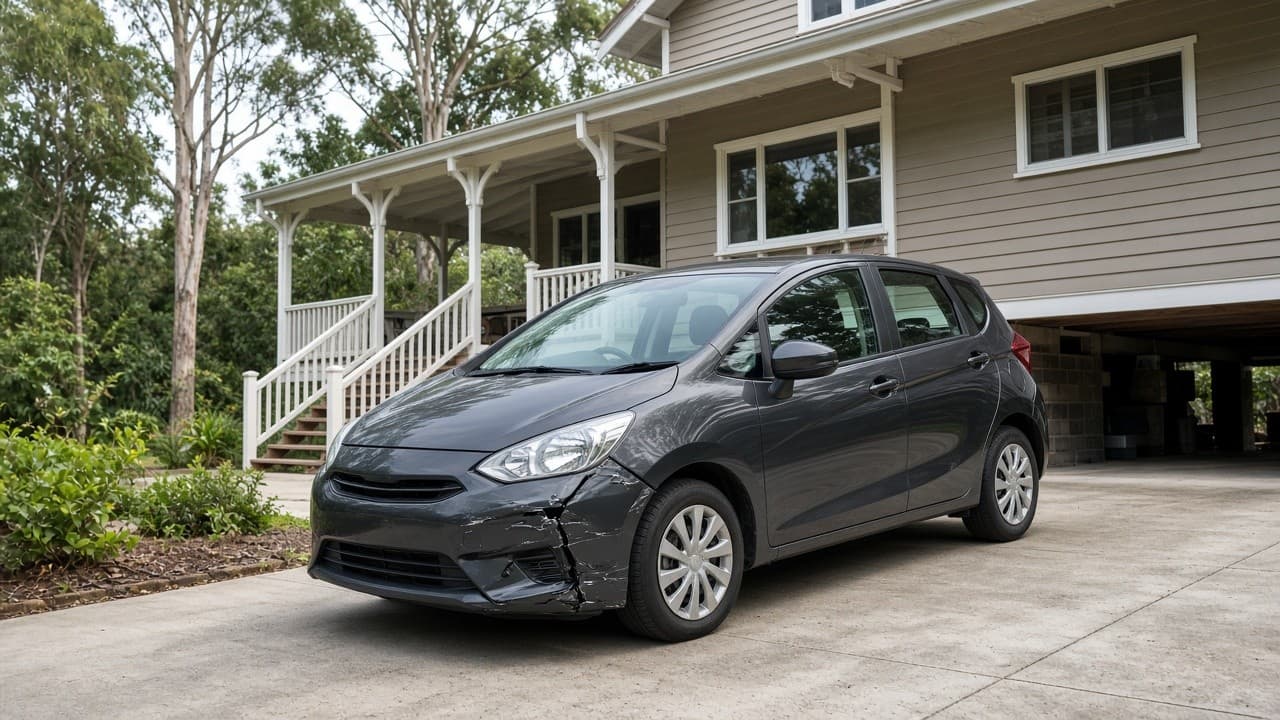
You can sell an accident-damaged car in QLD that hasn’t been written off, either as it is or after repairs. Before you decide, work out who pays for the damage, whether an insurance claim is worth it, and what a buyer will need. The right choice depends on the repair quote, the car’s value and who caused the crash.
Key takeaways
- Report the crash if the rules require it. You must report a crash to Queensland Police if someone needed medical attention, a driver didn’t give their details, or a vehicle was towed away. (Queensland Police Service)
- You choose the tow. In regulated areas, you decide who tows your car and where it goes, and you shouldn’t sign a blank towing authority. (Queensland Government)
- CTP won’t fix your car. Queensland CTP insurance covers injuries only, not damage to vehicles or property. (MAIC)
- An excess usually applies. You generally pay an excess when you claim, whether you’re at fault or not, unless your policy waives it. (Moneysmart)
- Private sales need a safety certificate. Crash damage must pass inspection before you can transfer rego privately, but a sale to a licensed motor dealer doesn’t need one. (Queensland Government)
What are your options for an accident-damaged car in QLD?
You usually have five options: repair it through your own insurer, pay for repairs yourself, claim from the at-fault driver, sell it privately as it is, or sell it to a licensed motor dealer or wrecker. Many owners combine them, for example claiming for repairs and then selling, or selling as-is to avoid the excess.
Compare the main paths.
| Option | Best when | Watch out for |
|---|---|---|
| Claim on your own comprehensive policy | The repair bill is well above your excess | Excess, a possible premium rise, and repair times |
| Pay for repairs yourself | The damage is minor and cheaper to fix than your excess | You carry the full cost if the quote grows |
| Claim from the at-fault driver or their insurer | Someone else caused the crash | You need their details and evidence, and it can take time |
| Sell privately as it is | The car is otherwise sound and you can deal with buyers | You need a safety certificate to transfer rego, and buyers will price in the damage |
| Sell to a licensed motor dealer or wrecker | Repairs cost more than they add, or you want a quick sale | Offers depend on the car, and you still need proof of ownership |
Sources: Moneysmart, Legal Aid Queensland and Queensland Government.
If your car is mechanically broken rather than crash-damaged, our guide to repairing or selling your broken car in Brisbane covers that decision.
What should you do straight after a crash in QLD?
Stop, make sure everyone is safe, and call 000 if anyone is hurt or there’s a hazard such as a fuel spill. Exchange details with the other drivers, take photos, and report the crash to police if the rules require it. Choose your own tow if the car can’t be driven. These steps protect any later claim or sale.
Queensland Police say you must report a crash to police if any of these apply (Queensland Police Service):
- Death or injury that needs medical attention from an ambulance officer, nurse or doctor.
- A driver failed or refused to give their details.
- A vehicle wasn’t driveable and was towed or carried away.
If none of these apply, you don’t have to report it. Where a car was towed and police didn’t attend, you can report it online, by calling Policelink on 131 444, or at a police station. Police say non-injury crash reports are available to insurance companies (Queensland Police Service).
Moneysmart suggests collecting the other driver’s name, address and phone number, the owner’s details if different, their licence and rego, their insurer, and the car’s make, model and colour. Your insurer may also ask for photos, witness details, the tow company and a police report number (Moneysmart).
What are your rights if your car needs a tow?
In Queensland’s tow truck regulated areas, crash towing has set rules. You can check whether an address is in a regulated area on the Queensland Globe map (Queensland Government; TMR):
| Rule | What it means for you |
|---|---|
| You choose the tow company | You can call your insurer first, as they may arrange the tow |
| You sign a towing authority before the tow | Don’t sign a blank or incomplete form. It must show the destination and fees |
| You choose the destination | Your home, a smash repairer or the operator’s holding yard |
| Storage is free for the first 72 hours | After that, daily fees can apply, with 2 days’ written notice |
| Crash towing fees are capped | The maximum is $433.30 for the first 50 km, plus $8.60 for each km after that, including GST |
Storage fees add up, so don’t leave a damaged car in a holding yard while you decide what to do. Towing it home can give you time to think, but you may pay for another tow later.
Has your car been written off, or is it just damaged?
It’s only a write-off if it’s a total economic loss: the repair cost plus the wreck’s salvage value is more than the car’s pre-crash market value. If your insurer or assessor says it’s repairable, or the damage is clearly worth fixing, it isn’t written off. A written-off status is permanent and shows on the PPSR.
TMR explains how this works in Queensland (Queensland Government):
- Notifiable vehicles. Light vehicles registered in Queensland, or unregistered and located here, that are 16 years old or younger when damaged must be recorded as written off if they’re a total economic loss.
- Who reports it. Usually the insurer, loss adjuster or another notifier tells TMR. If the car is uninsured and is a total loss, the owner must notify TMR, using form F4069, before selling or disposing of it (Queensland Government).
- Older cars. A car older than 16 when damaged isn’t recorded as a Queensland write-off, even if an insurer calls it one. It still must be repaired to a roadworthy condition before it goes back on the road.
Be honest with yourself about the numbers. If you’re uninsured and the repair bill plus scrap value is more than the car was worth, it may legally be a write-off you must report. Our guide to written-off cars and total loss claims in QLD explains what happens then. The rest of this guide is about cars that aren’t written off.
How do insurance, excess and fault affect your decision?
Your type of cover decides who pays. Comprehensive insurance covers your car even if you caused the crash. Third party property cover only pays for other people’s cars. Queensland CTP covers injuries, not vehicles. You’ll usually pay an excess when you claim, and an at-fault claim can affect your no claim bonus and premium.
| Cover | Repairs to your car? | Damage you cause to others? |
|---|---|---|
| CTP only (included in QLD rego) | No | No (injuries only) |
| Third party property damage | No | Yes |
| Third party property, fire and theft | Only for fire or theft | Yes |
| Comprehensive | Yes, even if you caused the crash | Yes |
Sources: Moneysmart and MAIC.
Things to check before you claim:
- Your excess. Moneysmart says you generally pay an excess whether you’re at fault or not. Some policies waive it in limited cases, and some charge it if the at-fault driver can’t be found.
- Whether it’s worth claiming. For minor damage, paying for repairs yourself can cost less than the excess plus a higher future premium.
- Your no claim bonus. An at-fault claim usually reduces or removes it. Moneysmart notes premiums can rise even after a not-at-fault claim, for example if the insurer can’t recover its costs from the other driver (Moneysmart).
- Exclusions. You may not be covered if the driver was affected by alcohol or drugs, or if the car was unregistered.
After you claim, your insurer must contact you within 10 business days, and a rejection must be in writing. If you’re unhappy with how the claim is handled, use the insurer’s internal complaints process first, then the free Australian Financial Complaints Authority (AFCA) (Moneysmart).
If you still owe money on the car, check your loan contract before deciding, because lenders often require insurance. Our guide to selling a car with finance owing in QLD explains payouts.
What if the other driver was at fault?
The person who caused the crash is responsible for the damage, so you can claim from them or their insurer even if you only have CTP. Send a letter of demand with repair quotes and towing receipts, setting a deadline such as 14 days. If they don’t pay, you can apply to QCAT for property damage claims up to $25,000.
Legal Aid Queensland sets out the usual steps (Legal Aid Queensland):
- Gather evidence. Photos, the other driver’s details, any police report number, witness details and at least one repair quote or valuation.
- Send a letter of demand to the other driver and to their insurer. If the driver and owner are different people, send one to each.
- Negotiate. The other insurer will usually want its assessor to inspect your car, so don’t sell or repair it before then without agreement.
- Escalate if needed. You can lodge a claim with QCAT, and AFCA may help if you have a dispute with the other driver’s insurer.
QCAT hears motor vehicle property damage disputes up to $25,000, excluding interest. Claims under $1,500 go straight to a hearing, and larger claims go to mediation first. Claims above $25,000 go to the courts (QCAT).
If fault is disputed, or you get a letter of demand yourself and you’re uninsured, get legal advice. Legal Aid Queensland’s number is 1300 65 11 88.
Should you repair the car or sell it as it is?
Repair it when the fixed car will be worth clearly more than the repair bill, plus any excess and the hassle. Sell it as it is when repairs cost close to, or more than, the value they add, or when the crash has revealed other problems. Get a written repair quote before deciding, so you’re comparing real numbers.
| Question | Leans towards repairing | Leans towards selling as-is |
|---|---|---|
| Who pays? | Your insurer or the at-fault driver pays most of it | You’d pay the full bill or a large excess |
| Size of repair | Cosmetic panels, a bumper or lights | Structural, airbag, suspension or cooling damage |
| Car’s age and value | Newer car with good resale value | Older or high-kilometre car with low value |
| Other faults | Well serviced and mechanically sound | Already due for tyres, brakes, timing belt or other big jobs |
| Your plans | You want to keep driving it | You were planning to replace it anyway |
Remember the selling costs too. To sell privately in Queensland while the car is registered, you need a current safety certificate. Approved inspection stations check items including tyres, brakes, steering, suspension, body rust or damage, the windscreen and lights. The fee for a car is $102.70 as at 1 July 2026, and repairs to pass come on top (Queensland Government).
For a sense of what a damaged car might be worth for parts and metal, see our guide to scrap car value in Brisbane, and for a private sale comparison, read selling privately vs selling to a car wrecker.
Do you have to tell buyers your car was in an accident?
Be upfront. Private sellers don’t give the consumer guarantees a dealer does, but a private sale is still a contract, and misleading a buyer about the car’s condition can lead to a legal dispute. Describe the crash damage and any repairs in the ad and on the receipt, and give buyers repair invoices and photos.
What the rules say:
- Private sellers. The Office of Fair Trading says private sellers aren’t bound by most consumer guarantees. Buyers get no cooling-off period or statutory warranty, but the guarantees for clear title, undisturbed possession and freedom from hidden securities still apply (Queensland Government).
- Buyers will check. OFT tells private buyers to get a PPSR certificate, an independent inspection and a test drive, and to check the car isn’t listed as written off (Queensland Government). A PPSR search costs $2 and shows any written-off status (PPSR).
- Dealers and write-offs. Motor dealers and auction houses selling a car recorded as written off must tell buyers it’s on the register (Queensland Government).
Disclosure also helps you sell. A buyer who discovers hidden damage during an inspection is likely to walk away or cut their offer sharply. Writing “sold with accident damage as described” on the receipt, with both signatures, gives you a clear record. Our QLD paperwork checklist for selling a car lists the documents to prepare, and our guide to avoiding scams when selling a car in QLD explains safe payment.
Can you drive or sell a crash-damaged car without a safety certificate?
You can’t drive it if the damage makes it unsafe. TMR says defective vehicles must be repaired to a roadworthy condition before they’re used on the road. You can sell it without a safety certificate to a licensed motor dealer, or sell it unregistered. A registered private sale needs a current certificate.
The legal ways to sell a damaged car that can’t pass a safety inspection are (Queensland Government):
- Repair all the defects, then get a safety certificate and sell privately.
- Sell to a licensed motor dealer. No safety certificate is needed for a sale to a dealer.
- Sell to an auto parts dismantler.
- Sell it unregistered. You don’t need an inspection, but the car needs an unregistered vehicle permit or a tow to be moved. See our guide to selling an unregistered car in QLD.
Selling a registered car privately without giving the buyer a current safety certificate can bring a fine of over $700 (Queensland Government). If police issued a defect notice after the crash, read our guide to defect notices in QLD. After any sale, make sure the rego leaves your name, as explained in our guide to transferring registration after selling a car in QLD.
How does selling an accident-damaged car to A1 Cash for Cars work?
Send us the make, model, year, kilometres and photos of the damage, and tell us whether the car starts, steers and rolls. We’re a licensed motor dealer, so you don’t need a safety certificate to sell to us, and the car doesn’t need to be repaired or driveable. We’ll explain our offer and the paperwork before you decide.
- Honest assessment. We don’t quote prices without knowing the car. Clear photos of the damage and the rest of the car help us assess it properly.
- Insurance first, if you’re claiming. If an insurer or the other driver’s insurer still needs to inspect the car, let that happen before you sell.
- Proof of ownership. Have your ID and your registration certificate or another document showing you own the car. If there’s finance owing, tell us early.
- Written-off cars too. We can often collect written-off cars, subject to ownership, insurer status and safe access.
- Safe collection. Tell us where the car is, such as your driveway, a smash repairer or a holding yard, and about any access limits.
- Responsible recycling. If the car is beyond repair, learn what happens next in our guide to car recycling in QLD, or see our page on cash for unwanted cars.
Frequently asked questions
Can I sell my car after an accident if it isn’t written off?
Yes. A car that isn’t a total loss can be sold as it is or after repairs. A private buyer needs a current safety certificate to transfer the rego, so the damage may need fixing first. You can sell to a licensed motor dealer without a safety certificate, or sell the car unregistered.
Do I have to report a minor crash to police in QLD?
Only in some cases. You must report a crash if someone needed medical attention, a driver failed or refused to give their details, or a vehicle was towed away. If none of these apply, you don’t have to report it. Towed-vehicle crashes police didn’t attend can be reported online or on 131 444.
Do I pay an excess if the accident wasn’t my fault?
Often, yes. Moneysmart says you generally pay an excess when you claim, whether you’re at fault or not, although some policies waive it in limited circumstances. Read your policy’s excess conditions carefully. Some policies, for example, still charge the excess if the at-fault driver can’t be found or identified.
Does CTP insurance cover damage to my car?
No. Queensland CTP insurance, which is paid with your rego, covers personal injury only. It doesn’t cover damage to your car or anyone’s property. Repairs to your car are covered by comprehensive insurance, or by the at-fault driver or their insurer if someone else caused the crash.
The at-fault driver has no insurance. What can I do?
Send them a letter of demand with copies of repair quotes and towing receipts, asking for payment within a set time such as 14 days. If they don’t pay or respond, you can apply to QCAT, which hears motor vehicle property damage disputes up to $25,000. Legal Aid Queensland can give advice.
Is it worth claiming on insurance for minor damage?
Sometimes not. If the repair costs less than your excess, or only slightly more, paying yourself can be cheaper, especially as a claim can affect your no claim bonus and future premiums. Get a written repair quote, compare it with your excess, and ask your insurer how a claim would affect your premium.
Do I have to tell a buyer my car has been in an accident?
You should. Private sellers don’t give statutory warranties, but a private sale is still a contract, and misleading a buyer can lead to a legal dispute. Buyers can also check PPSR records and get inspections. Describe the damage and repairs in writing, and note it on the receipt.
Sources and further reading
- Traffic crash FAQs, Queensland Police Service
- Reporting a traffic crash, Queensland Police Service
- Crash towing, Queensland Government (Transport and Main Roads)
- Tow truck licensing scheme, Department of Transport and Main Roads
- How the Written-off Vehicle Scheme works, Queensland Government (Transport and Main Roads)
- Notifying of written-off vehicles, Queensland Government (Transport and Main Roads)
- Safety certificates, Queensland Government (Transport and Main Roads)
- Selling a used vehicle, Queensland Government (Transport and Main Roads)
- What is CTP insurance?, Motor Accident Insurance Commission
- Claiming on your car insurance, Moneysmart (ASIC)
- Choosing car insurance, Moneysmart (ASIC)
- No claim bonus on car insurance, Moneysmart (ASIC)
- Car accidents, Legal Aid Queensland
- Property damage caused by a motor vehicle, Queensland Civil and Administrative Tribunal
- Buying used cars privately, Office of Fair Trading Queensland
- Buying goods at private sales or auction, Office of Fair Trading Queensland
- PPSR Car Check, Australian Financial Security Authority
About the author
A1 Cash for Cars Team. A1 Cash for Cars is a licensed motor dealer at 60 Bowhill Rd, Willawong, buying unwanted, damaged and non-running vehicles across South East Queensland. This guide is general information, not legal, financial or insurance advice. Insurance policies differ and rules can change, so check your policy, the linked official pages, or get advice about your situation.
Ready to sell a crash-damaged car?
Call 0400 119 641 or request a quote. Tell us the year, model, kilometres, what was damaged and where the car is, and we’ll explain your options and the paperwork before you decide.
Last updated
Ready to find out what your car is worth?
Send us your vehicle details to request a quote.