
By A1 Cash for Cars Team · Last updated: 31 October 2026
A1 Cash for Cars is a Brisbane vehicle buyer and licensed motor dealer with a yard at 60 Bowhill Rd, Willawong. We assess and buy unwanted, damaged, scrap and non-running cars, utes, vans and 4WDs across Greater Brisbane.
Yes, in most cases. You need a current safety certificate to sell a car in QLD when you sell a registered car privately and the registration is transferred to the buyer. You don’t need one if the car is unregistered, if you sell it to a licensed motor dealer, or if a Transport and Main Roads (TMR) exemption applies.
Key takeaways
- Private sale of a registered car needs one. You must get a safety certificate before disposing of a registered vehicle other than to a dealer, and give it to the buyer. (Queensland Government)
- Some sales don’t. Unregistered vehicles, sales to licensed motor dealers, transfers between spouses and some other situations are exempt. (Queensland Government; TMR form F3520)
- Private sellers get 2 months or 2,000 km. The certificate expires at whichever comes first, and it covers only one transfer. (Queensland Government)
- Only an approved inspection station can issue one. TMR lists a fee of $102.70 for motor vehicles up to 4,500 kg GVM, as at 1 July 2026. (Queensland Government)
- Skipping it can cost you. TMR says you may be fined over $700, and you stay liable for tolls and fines until the rego leaves your name. (Queensland Government)
When do you need a safety certificate to sell a car in QLD?
You need one when you sell or give away a registered car and the registration is transferred to a new owner, unless an exemption applies. TMR says it’s the seller’s job, not the buyer’s, to get the certificate and hand it over. The same inspection is also needed when re-registering an unregistered car or bringing one over from interstate.
TMR’s safety certificate page says a safety certificate is needed when:
- transferring registration to a new owner
- transferring to Queensland registration from another state or territory
- re-registering an unregistered vehicle.
It applies to cars, motorcycles, trailers and caravans with an aggregate trailer mass (ATM) between 750 kg and 4,500 kg, and other vehicles up to 4,500 kg gross vehicle mass (GVM). Heavier vehicles, buses and public passenger vehicles need a certificate of inspection (COI) instead (Queensland Government).
If your car has an LPG or other gas system, you’ll also need a gas certificate from an authorised gas installer. Its issue date must be no more than 3 months old when the registration is transferred (Queensland Government).
When don’t you need a safety certificate to sell a car?
You don’t need one when the car is unregistered at the time of sale, when you sell to a licensed motor dealer, or when TMR’s exemptions cover the transfer. Common exemptions include transfers between spouses, to a surviving spouse or a deceased estate beneficiary, and cars garaged in certain remote or exempt areas of Queensland.
The table below draws on TMR’s safety certificate page and the exemption list on its Vehicle Registration Transfer Application (form F3520).
| Situation | Safety certificate needed? | What to know |
|---|---|---|
| Registered car sold privately | Yes | Get it before the sale and give it to the buyer so they can transfer the rego |
| Unregistered car sold privately | No | The buyer will need one if they want to re-register it. You need a permit to move it on the road |
| Sold to a licensed motor dealer | No | Sales to, or between, licensed motor dealers are exempt |
| Transfer between spouses | No | Includes separated married couples and registered partners until the divorce or end of the registered relationship is finalised |
| Transfer to a surviving spouse or a deceased estate beneficiary | No | Further evidence may be needed to verify the exemption |
| Adding or removing a name, with one registered operator staying the same | No | Applies to transfers to or from joint names |
| Car garaged in an exempt area at the time of sale | No | The form lists local government areas such as Aurukun, Boulia, Croydon, Diamantina, Quilpie and the Torres Strait Islands, plus some remote localities (contact TMR) |
| Car garaged on a Queensland island with no approved inspection station | No | Applies to vehicles under 4.5 tonnes |
| Sold for parts | No, once de-registered | TMR says cars can be sold for parts, but they must be de-registered before being sold |
| Gift or sale to another relative, such as a child or sibling | Generally yes | Family transfers other than spouses aren’t on TMR’s exemption list. Check with TMR on 13 23 80 |
Sources: Queensland Government; TMR form F3520.
Selling an unregistered car has its own steps. Our guide to selling an unregistered car in QLD covers the paperwork and how to move it legally. If you’re handling a late family member’s car, see selling a deceased estate car in QLD.
Do you need a safety certificate before you advertise your car?
No. TMR says a safety certificate is no longer required before you offer a registered vehicle for sale. You must still have a current one before you dispose of the car, other than to a dealer. Many sellers get it once a buyer is lined up, so the certificate doesn’t expire while the car is listed.
If you do have a certificate while the car is advertised, TMR’s guide for buyers says handwritten safety certificates must be displayed on the vehicle. Electronic certificates don’t need to be displayed, but if a buyer asks, you must show it so they can check it’s valid. That can be a printed copy or a copy on your phone, tablet or computer (Queensland Government).
Getting the inspection done before listing can still help. A buyer can see the car has passed recent basic safety checks, and you’ll know about any defects before you set a price. Just watch the expiry date and kilometres.
How long is a safety certificate valid in QLD?
For a private seller, a safety certificate is valid for 2 months or 2,000 km from the date of issue, whichever comes first. For licensed motor dealers, it’s 3 months or 1,000 km. Each certificate covers one transfer only, so you need a new one every time the car is sold.
| Who is selling | Valid for (whichever expires first) |
|---|---|
| Private sellers and all other sellers | 2 months or 2,000 km from the date of issue |
| Licensed motor dealers | 3 months or 1,000 km from the date of issue |
Source: Queensland Government.
A few rules about using the certificate:
- One transfer only. You’ll need a new certificate each time you sell, even if the old one is still within its time and distance limits.
- Registering, then transferring. You can use the same certificate to register an unregistered vehicle and then transfer the registration, as long as both happen within the limits.
- Current at the date of disposal. TMR’s transfer form says the certificate must be issued in Queensland and be current on the date you dispose of the car (TMR form F3520).
Where do you get a safety certificate, and what does it cost?
Only an approved inspection station (AIS) can issue a safety certificate in Queensland. These are workshops, service stations or mobile inspectors approved by TMR, with accredited examiners. You can search for one by suburb or postcode online. TMR lists the inspection fee for a car up to 4,500 kg GVM as $102.70, as at 1 July 2026.
Use TMR’s Find an Approved Inspection Station search to look up stations by location, inspection type, mobile service, or whether they issue electronic certificates (Queensland Government).
TMR lists these inspection fees, including GST:
| Vehicle type | Fee (as at 1 July 2026) |
|---|---|
| Motor vehicles up to 4,500 kg GVM | $102.70 |
| Trailers over 750 kg up to 4,500 kg ATM | $51.45 |
| Motorcycles | $66.00 |
| Replacement inspection certificate issued by TMR | $28.00 |
Source: Queensland Government. TMR’s fees and charges rise on 1 July each year, so check the page for the current figure. Repairs needed to pass are extra.
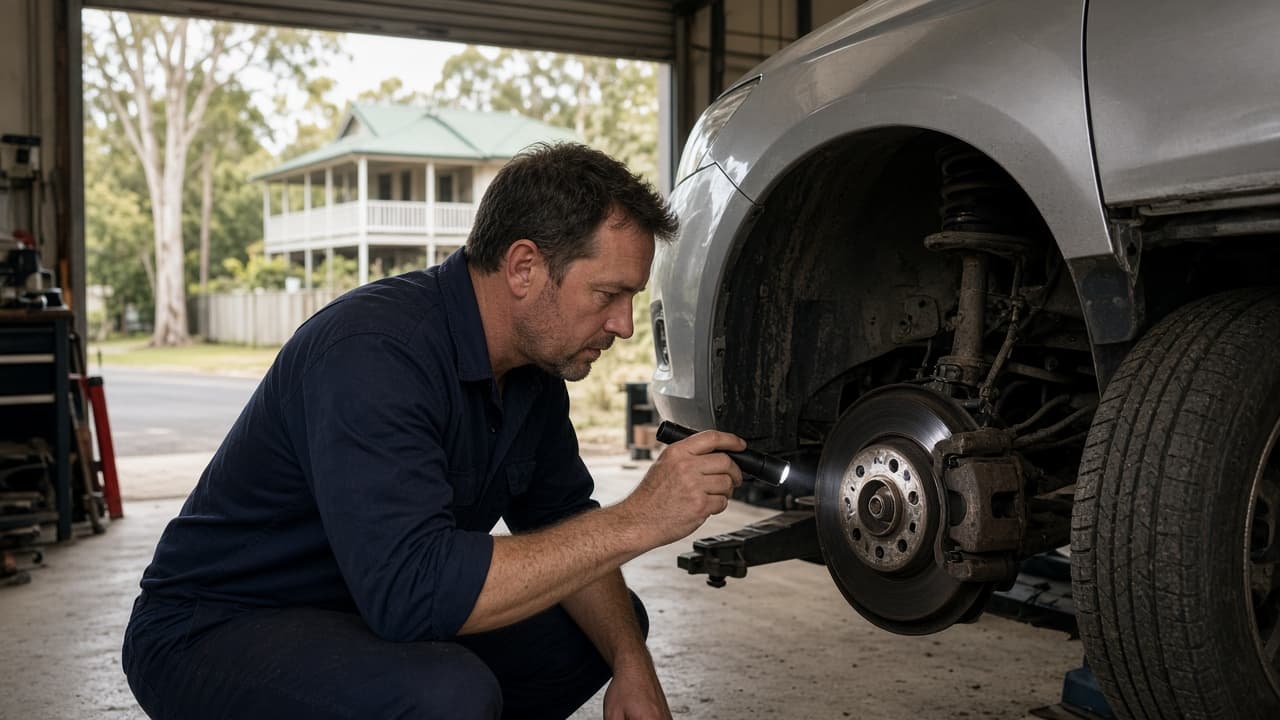
What the inspection checks. The examiner looks at basic safety standards, including tyres, brakes, steering, suspension, body rust or damage, the windscreen and lights. TMR’s Vehicle Inspection Manuals explain how the inspection is done and why a vehicle may fail.
What it doesn’t check. TMR stresses that a safety certificate is not a full mechanical inspection of a car’s quality or life expectancy. Buyers who want that should arrange a separate pre-purchase inspection, for example through a motoring group such as RACQ (Queensland Government).
What happens if your car fails the safety inspection?
If the examiner finds defects, you get an inspection report listing what needs fixing instead of a certificate. Return the car to the same station within 14 days for a reinspection of those items. After 14 days, a new full inspection is needed, and a new inspection fee may be charged.
TMR’s rules for approved inspection stations explain the reinspection process (TMR):
- Same examiner where possible. The examiner who issued the report does the reinspection, or another examiner approved at that station.
- If no examiner is available. The station must arrange a reinspection at another convenient time at no further cost, or refund the original inspection fee.
- How the 14 days are counted. The period starts the day after you receive the report. If the last day falls on a weekend or public holiday, it moves to the next business day.
- Pass or fail. If the defects are fixed, you get the certificate straight away. If not, you get another report saying what’s still wrong.
If the repairs cost more than the car is worth, TMR’s own advice for a car in unsafe or defective condition is to repair all the defects, sell it to a dealer or an auto parts dismantler, or sell it unregistered (Queensland Government). If the car already has a defect notice from a roadside inspection, read selling a car with a defect notice in QLD for the extra rules.
What are the penalties for selling without a safety certificate?
TMR says you may be fined over $700 for not having a current safety certificate when you dispose of a registered car, or for failing to give one to the new owner. There are also on-the-spot fines for not handing over the certificate. Without it, the buyer can’t transfer the registration out of your name.
That last point is the hidden cost. TMR says you remain liable for any tolls and infringement notices for the vehicle while it’s still registered in your name (Queensland Government; Queensland Government). A sale that stalls on paperwork can leave you paying for someone else’s driving.
There’s also the buyer’s side. A buyer who can’t register the car may refuse to complete the sale or come back to you. Private sales also come with fewer protections for buyers. The Queensland Government says private buyers don’t get a cooling-off period or a statutory warranty (Queensland Government), so a valid certificate and clear paperwork help both sides.
How do you hand over the safety certificate when you sell?
Give the buyer the original copy of a handwritten certificate, or a digital copy or the certificate number of an electronic one. Then complete the registration transfer together, on paper or online. The buyer must lodge the transfer within 14 days, and you should keep a copy of everything for your records.
TMR’s transfer steps say to give the buyer:
- Handwritten certificates. The original blue copy.
- Electronic certificates. A printed copy, or the certificate number written on the transfer application form. If the buyer asks, you must show them the electronic certificate so they can check it’s valid.
Most electronic certificates are submitted to TMR by the inspection station, which may let you and the buyer transfer the registration online (Queensland Government). TMR’s transfer form warns that it may be an offence if the buyer doesn’t lodge the transfer within 14 days of acquiring the vehicle (TMR form F3520).
Before the handover, also remove the car from any rego direct debit and take out your toll tag (Queensland Government). For the full checklist, see our guides to transferring registration after selling a car in QLD and the paperwork you need to sell a car in QLD. And because certificates and payments are a common target, read how to avoid scams when selling a car in QLD before meeting buyers.
Is it easier to sell to a licensed motor dealer?
Often, yes, especially for older, damaged or non-running cars. TMR describes selling to a licensed motor dealer as the easiest way to sell a vehicle, and no safety certificate is needed. That means no inspection fee, no repairs to pass, and no risk of the certificate expiring while you wait for a private buyer.
| Private sale (registered car) | Sale to a licensed motor dealer | |
|---|---|---|
| Safety certificate | Needed, unless an exemption applies | Not needed |
| Repairs to pass inspection | Usually needed | Not needed to sell |
| Expiry risk | 2 months or 2,000 km | None |
| Registration transfer | Seller and buyer complete it | The dealer handles its side of the paperwork |
| Price | Often higher for a roadworthy car | Reflects the car’s condition and resale or parts value |
Sources: Queensland Government; Queensland Government.
Before you sell to any business, check it holds a motor dealer licence on the Office of Fair Trading’s licensing register. The Queensland Government’s guide to guarantees and warranties when buying a vehicle explains the extra rules licensed dealers must follow when they resell. If you’re still weighing it up, our comparison of selling privately vs selling to a car wrecker may help.
How does selling your car to A1 Cash for Cars work?
Tell us the make, model and year, its condition, whether it’s registered and where it is. We’re a licensed motor dealer, so you don’t need a safety certificate to sell to us, and you don’t have to fix defects first. We’ll explain how the rego, plates and paperwork will be handled, then arrange collection if you accept our offer.
- Any condition. We assess unwanted, damaged, non-running and scrap cars, utes, vans and 4WDs.
- No safety certificate needed. Queensland doesn’t require one when you sell to a licensed motor dealer.
- Written-off cars. We can often collect written-off cars, subject to ownership, insurer status and safe access.
- Honest assessment. We don’t quote prices without knowing the car.
- Easy to verify. Call us on 0400 119 641 or visit our yard at 60 Bowhill Rd, Willawong. See our page on cash for unwanted cars.
Frequently asked questions
Can I sell my car without a safety certificate in QLD?
Yes, in some cases. You can sell without one if the car is unregistered, if you sell to a licensed motor dealer, or if an exemption applies, such as a transfer between spouses. For a private sale of a registered car, you need a current safety certificate unless an exemption covers it.
Who has to get the safety certificate, the buyer or the seller?
The seller. TMR says it’s not the new owner’s obligation to get a safety certificate. The seller must get a current certificate and give it to the buyer, and may be fined over $700 for failing to do so. The buyer needs it to transfer the registration.
Can I use the same safety certificate twice?
No. A safety certificate covers one transfer only, so you need a new one each time the car is sold, even if the old certificate is still within its time and distance limits. You can use one certificate to register an unregistered car and then transfer it, if both happen within the limits.
How long does a safety certificate last for a private sale in QLD?
For private sellers, a safety certificate is valid for 2 months or 2,000 km from the date of issue, whichever comes first. Certificates issued for licensed motor dealer sales are valid for 3 months or 1,000 km. It must still be current on the day you dispose of the car.
Do I need a safety certificate to sell my car to a wrecker?
Not if the wrecker is a licensed motor dealer, because sales to licensed dealers are exempt. TMR also says cars can be sold for parts, but they must be de-registered before being sold. Check the business’s licence on the Fair Trading licensing register and ask how it will handle the rego.
Do I need a safety certificate to give my car to a family member?
It depends on who. Transfers between spouses, to a surviving spouse and to a deceased estate beneficiary are exempt. Other family transfers, such as a gift to a child or sibling, aren’t on TMR’s exemption list, so a safety certificate is generally needed. Call TMR on 13 23 80 if you’re unsure.
Is a safety certificate the same as a roadworthy or a full mechanical check?
A Queensland safety certificate is often called a roadworthy, but it only covers basic safety items such as tyres, brakes, steering, suspension, rust, the windscreen and lights. TMR says it isn’t a comprehensive mechanical inspection of the car’s quality or life expectancy.
Sources and further reading
- Safety certificates, Queensland Government (Transport and Main Roads)
- Selling a used vehicle, Queensland Government (Transport and Main Roads)
- Buying a used vehicle, Queensland Government (Transport and Main Roads)
- Certificates issued by approved inspection stations, Queensland Government (Transport and Main Roads)
- Find an Approved Inspection Station, Department of Transport and Main Roads
- Approved inspection station approval holder and nominee responsibilities, Department of Transport and Main Roads
- Vehicle Registration Transfer Application (form F3520), Department of Transport and Main Roads
- How to transfer a Queensland registered vehicle in person, Queensland Government (Transport and Main Roads)
- How to transfer a Queensland registered vehicle online, Queensland Government (Transport and Main Roads)
- Guarantees and warranties when buying a vehicle, Queensland Government
- Fair Trading licensing register, Office of Fair Trading Queensland
About the author
A1 Cash for Cars Team. A1 Cash for Cars is a licensed motor dealer at 60 Bowhill Rd, Willawong, buying unwanted, damaged and non-running vehicles across South East Queensland. This guide is general information, not legal advice. Rules, fees and penalties can change, so check the linked official pages or contact TMR on 13 23 80 about your situation.
Ready to sell without the safety certificate hassle?
Call 0400 119 641 or request a quote. Tell us the year, model, condition, rego status and where the car is, and we’ll explain your options and how the paperwork works before you decide.
Last updated
Ready to find out what your car is worth?
Send us your vehicle details to request a quote.