
By A1 Cash for Cars Team · Last updated: 27 October 2026
A1 Cash for Cars is a Brisbane vehicle buyer and licensed motor dealer with a yard at 60 Bowhill Rd, Willawong. We assess and buy unwanted, damaged, scrap and non-running cars, utes, vans and 4WDs across Greater Brisbane.
Yes, you can sell a flood-damaged car in QLD, but safety and paperwork come first. Don’t try to start it, contact your insurer if you’re covered, and find out whether it’s been written off. A statutory write-off can only go for parts or scrap, while other flood cars can be repaired, sold as is or sold to a dealer.
Key takeaways
- Don’t start or drive a flooded car. Starting it can pull water into the engine, and flooded electric and hybrid cars carry a risk of electrocution or fire. (RACQ)
- Comprehensive cover usually includes weather events. Third party, fire and theft cover generally doesn’t pay for flood damage to your own car. Check your policy. (Moneysmart)
- Water above the inner door sill usually means a statutory write-off. Under the national damage criteria, a written-off light vehicle with water in the cabin above the inner door sill must be classed as a statutory write-off. (Transport WA)
- A statutory write-off can never be re-registered in Australia. It can only be used for parts or scrap, and the status shows permanently on the PPSR. (Queensland Government)
- Selling to a licensed motor dealer doesn’t need a safety certificate. Neither do unregistered vehicles. A1 Cash for Cars is a licensed motor dealer. (Queensland Government)
Can you sell a flood-damaged car in QLD?
Yes. Queensland law doesn’t stop you selling a car that’s been in a flood. What you can do with it depends on whether it’s insured, whether it’s been written off and how badly the water got in. A statutory write-off can only be sold for parts or scrap, so it can’t go back on the road.
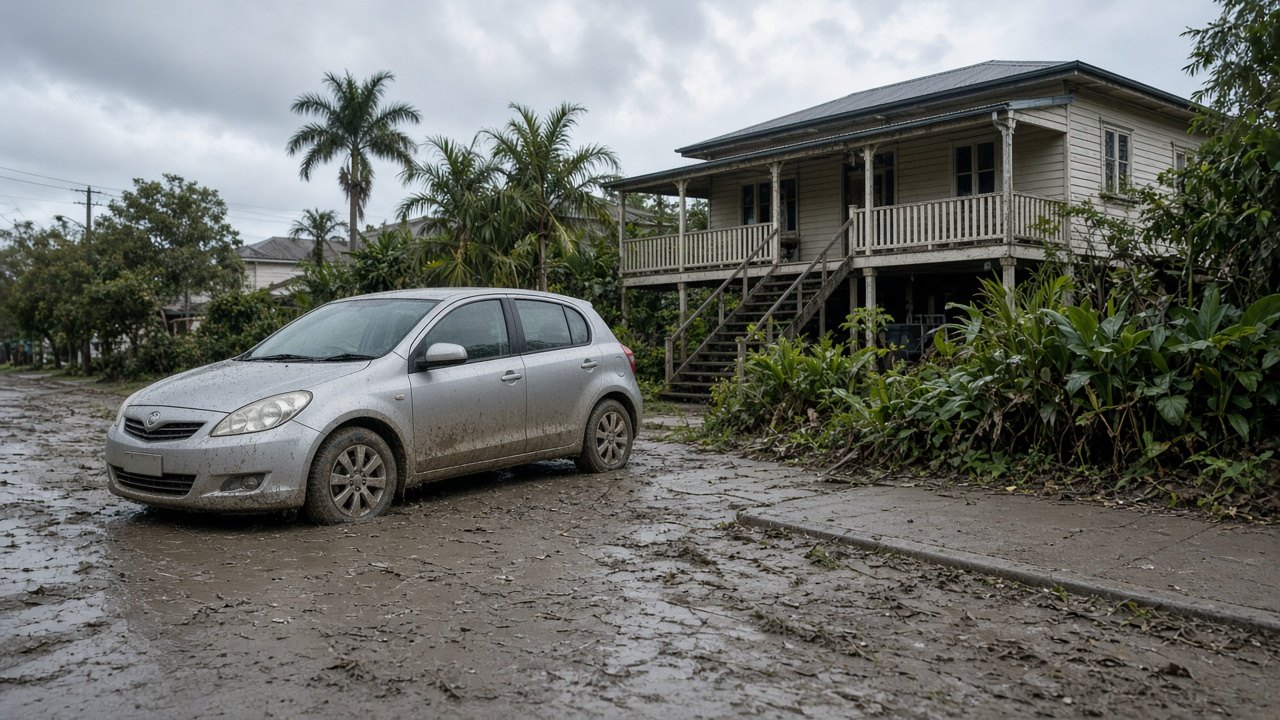
Brisbane’s storm and wet season usually runs from about November to March, and every year some cars end up in flash flooding, flooded garages or low-lying streets. A car that has sat in water can look fine once it dries, but the damage is often hidden in the electrics, engine, airbags and interior.
Broadly, there are four paths for a flood-damaged car:
- An insurance claim, if you have comprehensive cover. The insurer decides whether to repair it or write it off.
- Repair it, if the damage is light and the numbers stack up.
- Sell it as is, privately or to a dealer, with honest disclosure.
- Sell it for parts or scrap, which is the only option for a statutory write-off.
If your car has storm damage from hail rather than water, our hail-damaged car guide covers that situation instead.
What should you do first if your car has been in a flood?
Put safety first. Don’t go near floodwater, and don’t try to start or drive the car once the water drops. Take photos and videos of the damage, including the water line inside and out. Then contact your insurer as soon as you can, even if you don’t yet know how bad the damage is.
The Insurance Council of Australia (ICA) advises that you don’t drive a vehicle that has suffered water damage, and that you lodge a claim early and document the damage. A practical order of steps:
- Stay safe. Only return to the car when emergency services say it’s safe. Queensland’s message is simple: if it’s flooded, forget it.
- Don’t start it. RACQ warns that if the engine is started, water can be pulled in through the intake and the engine can hydraulic lock, which is very likely to cause internal damage such as bent conrods and valves.
- Take extra care with EVs and hybrids. RACQ says flooded vehicles with high-voltage batteries risk electrocution or fire from short circuits. They should only be towed to an authorised repairer and inspected, and the tow operator must know it’s been flooded.
- Document everything. Photograph the water line on the body and inside the cabin, wet carpets, the engine bay and the boot.
- Call your insurer. Lodge the claim, ask how the car will be assessed and follow their instructions before arranging towing or repairs.
- If you’re not insured, have a mechanic inspect the car before deciding whether to repair or sell.
Will your insurer write off a flood-damaged car?
Often, yes. Flooded cars are expensive to fix properly because water damages wiring connectors, electronics, the interior and sometimes the engine. If repairs plus the wreck’s salvage value cost more than the car is worth, it’s a total loss. Whether you’re covered at all depends on your policy type, so check your PDS.
Moneysmart explains how the main types of car insurance differ:
| Policy type | Does it cover flood damage to your own car? |
|---|---|
| Compulsory Third Party (CTP) | No. CTP covers injuries to people, not damage to cars |
| Third party property damage | No. It covers damage you cause to other people’s cars or property |
| Third party, fire and theft | Generally no. It adds cover if your car is stolen or damaged by fire |
| Comprehensive | Usually yes. It covers your car for weather events, subject to the policy’s exclusions |
RACQ’s technical team says the repair work on a flooded car is expensive and ongoing problems are highly likely, “which is why insurance will simply write off a flooded vehicle.” In Queensland, a car is a total economic loss when its pre-damage market value is lower than the cost of repairs plus its salvage value, and water immersion is one of the listed causes.
If the insurer pays out a total loss, it normally keeps the wreck. Some insurers may let you keep it, with the salvage value deducted from your payout. Our guide to written-off cars and insurance total losses in QLD explains the payout, salvage and dispute steps in detail.
Statutory or repairable write-off: what’s the difference for a flood car?
A statutory write-off can never be re-registered in Australia and can only be used for parts or scrap. A repairable write-off can return to the road after repairs, a safety certificate inspection and a written-off vehicle inspection. For flood damage, water inside the cabin above the inner door sill usually means statutory.
When a notifiable vehicle becomes a total loss, the assessor (called the notifier) must classify it as statutory or repairable using standardised damage criteria, and report it to the Department of Transport and Main Roads (TMR). Under the national criteria, a light vehicle whose internal cabin is inundated with any water above the level of the inner door sill, for any period, must be classed as a statutory write-off. Fresh, salt and brackish water are all treated the same.
| Statutory write-off | Repairable write-off | |
|---|---|---|
| Can it be re-registered? | No, never in Australia | Yes, after repairs and inspections |
| What it can be used for | Parts or scrap metal only | Repair and return to the road |
| Inspections needed | Not applicable | Safety certificate inspection and a written-off vehicle inspection (WOVI) |
| Airbags | Airbags from water-damaged vehicles can’t be reused | Repairer must restore it to a roadworthy standard |
| Record | Permanent, shows on the PPSR | Permanent, shows on the PPSR |
According to the Queensland Government, parts that can’t be reused from a statutory write-off include components that record the VIN, the chassis of a body-on-frame vehicle, and airbags that have come from a water-damaged vehicle. Other functional parts can be reused.
Not every car can be written off on the register. In Queensland, a light vehicle is only “notifiable” if it’s 16 years or younger when it becomes a total loss. An older car your insurer calls a write-off may not be recorded on the register, but a write-off status that’s already recorded stays permanently.
How can you tell if a car has flood damage?
Look for a water line, silt or mud in hidden places, a musty or mouldy smell, damp or replaced carpets, corrosion on metal under the dash and seats, and electrical faults. A PPSR search shows whether the car is recorded as written off, but a flooded car that was never insured may not appear.
| Sign | Where to check |
|---|---|
| Water line or tide mark | Door panels, seat frames, boot, inside the headlights and tail lights |
| Silt, mud or debris | Under carpets and seats, spare wheel well, seat rails, air filter box |
| Musty or mouldy smell | Carpets, seat foam, headlining and air-conditioning vents |
| Corrosion | Seat bolts, pedal brackets, wiring connectors and metal under the dash |
| Electrical faults | Warning lights, windows, central locking, infotainment, airbag light |
| Fogging or moisture | Headlights, tail lights, instrument cluster |
RACQ notes that even after a car’s interior is stripped and dried, corrosion can keep forming in wiring plugs and connectors, and the carpets, seats and linings can hold mould and contaminants. That’s why flood damage can show up weeks or months later.
If you’re buying a used car after a wet season, a $2 PPSR search will show any recorded write-off, and a mechanical inspection is worth the cost. Queensland Fair Trading’s advice on water-damaged products also suggests looking out for signs of water damage when buying a second-hand vehicle.
Do you have to tell buyers your car was flood damaged?
Dealers and auctioneers must tell buyers if a car is a statutory or repairable write-off, and businesses must not mislead buyers about water damage. Private sellers have fewer formal obligations, but being upfront is the safest course. Write-off status shows on a PPSR search, and hidden flood damage often leads to disputes.
What the official guidance says:
- Businesses selling water-damaged goods must not mislead consumers about their history and must make it clear the goods have or had water damage, according to Queensland Fair Trading.
- Motor dealers and auctioneers selling a car with a written-off classification must tell the buyer whether it’s recorded as a repairable or statutory write-off, as TMR’s written-off vehicle notification page explains.
- Private sellers aren’t required by TMR to tell buyers about a car’s write-off status, but buyers can see it on the PPSR. Honest disclosure of flood damage protects you and the buyer.
- Uninsured total losses may need to be reported. If your car is a notifiable vehicle and a total loss, and no insurer or other notifier has reported it, TMR says you must notify it using form F4069 before you sell or dispose of it.
Do you need a safety certificate to sell a flood-damaged car?
Only if you sell a registered car privately. You don’t need one if the car is unregistered, or if you sell or trade it to a licensed motor dealer. A statutory write-off can’t be registered, and a flooded car that’s still registered may struggle to pass a safety certificate inspection.
The Queensland Government’s safety certificates page says:
- You must give a current safety certificate when you dispose of a registered vehicle, other than to a dealer, and you may be fined over $700 if you don’t.
- Unregistered vehicles, and vehicles traded to licensed motor dealers, don’t need a safety certificate.
- Vehicles sold for parts must be de-registered before they’re sold.
For the paperwork, a registered car needs the registration transferred out of your name within 14 days using form F3520, or online if you’re eligible. If the car is being scrapped or sold for parts, you can cancel the registration with form F3517 and hand in the plates, unless an exception applies, and you may get a refund of unused registration. Our QLD paperwork checklist for selling a car covers every form in detail, and our guide to selling an unregistered car in QLD explains moving an unregistered car legally.
Is it worth repairing a flood-damaged car?
Usually only when the water stayed below the cabin floor and the electrics, engine and airbags check out. Once water gets inside the cabin, repairs get expensive and problems can keep appearing. For most owners, an insurance claim or selling the car as is makes more sense than a big repair bill.
Questions to ask before you repair:
- How high did the water get? Water above the inner door sill is the line that turns a written-off car into a statutory write-off.
- Was the engine started while flooded? If so, ask a mechanic to check for internal damage before spending anything else.
- Is it an EV or hybrid? High-voltage systems need an authorised repairer.
- What’s the full quote? Include wiring, modules, carpets, seats, airbag components and mould treatment, not just the engine.
- What’s the car worth after repair? Compare that with what it’s worth as is, and remember any write-off status stays on the PPSR permanently.
For a step-by-step way to weigh this up, see repair or sell your broken car in Brisbane. If the car won’t start after the flood, our guide to selling a car that won’t start may also help.
How does selling a flood-damaged car to A1 Cash for Cars work?
Tell us the make, model, year, how high the water got, whether it’s been started, and whether an insurer has assessed or written it off. We’re a licensed motor dealer, so you don’t need a safety certificate to sell to us. We’ll assess the car honestly and explain your options.
- Flood, water and storm damage. We look at flood-damaged, non-running and written-off cars, utes, vans and 4WDs, subject to ownership, insurer status and safe access.
- Check with your insurer first. If you’ve made a claim, the insurer may own the car once it pays out, so confirm who can sell it before you contact a buyer.
- No safety certificate needed. Queensland doesn’t require one when you sell to a licensed motor dealer.
- Honest assessment. Every offer depends on the car’s condition and history, so we don’t quote prices without knowing the vehicle.
- Where we work. From our Willawong yard we cover Brisbane North and South, Logan, Ipswich, Moreton Bay, mainland Redlands and selected Gold Coast suburbs. See our service locations and our page on cash for unwanted cars.
- Safe collection. Tell us where the car is, whether the area is still wet or muddy, and about gates, slopes and clearance so collection can be planned safely.
Frequently asked questions
Can I sell a flood-damaged car in Queensland?
Yes. You can sell it privately, to a dealer or for parts or scrap. If it’s recorded as a statutory write-off, it can only be sold for parts or scrap metal and can never be re-registered in Australia.
Should I start my car after a flood?
No. Starting a flooded engine can pull water into it and cause serious internal damage. Flooded electric and hybrid cars can also pose a risk of electrocution or fire, so have them towed and inspected.
Does car insurance cover flood damage in QLD?
Comprehensive car insurance usually covers weather events such as floods, subject to its exclusions. CTP, third party property damage and third party, fire and theft policies generally don’t cover flood damage to your own car. Check your PDS.
What makes a flooded car a statutory write-off?
Under the national damage criteria, a written-off light vehicle is classed as a statutory write-off if water entered the cabin above the inner door sill for any period. It doesn’t matter whether the water was fresh, salt or brackish.
Can a flood-damaged car be repaired and re-registered?
Only if it isn’t a statutory write-off. A repairable write-off can be re-registered after it passes a safety certificate inspection and a written-off vehicle inspection. A car that was never written off must still be roadworthy.
Do I need to tell a buyer my car was in a flood?
Dealers and auctioneers must disclose a car’s write-off status, and businesses must not mislead buyers about water damage. Private sellers have fewer formal obligations, but honest disclosure is safest because write-off status appears on a PPSR search.
Do I need a safety certificate to sell a flood-damaged car to a dealer?
No. In Queensland, vehicles traded to licensed motor dealers, and unregistered vehicles, don’t need a safety certificate. A private sale of a registered car does need one.
Sources and further reading
- How the Written-off Vehicle Scheme works, Queensland Government (Transport and Main Roads)
- Notifying of written-off vehicles, Queensland Government (Transport and Main Roads)
- Water-damaged products, Queensland Government (Office of Fair Trading)
- Safety certificates, Queensland Government (Transport and Main Roads)
- How to transfer a Queensland registered vehicle online, Queensland Government (Transport and Main Roads)
- Cancelling your vehicle registration, Queensland Government (Transport and Main Roads)
- If it’s flooded, forget it, Get Ready Queensland (Queensland Government)
- Statutory written-off vehicles, Department of Transport WA (summary of the national damage assessment criteria)
- What to do when you return to your property after flood, Insurance Council of Australia
- What to do if your vehicle has been flooded, RACQ
- Choosing car insurance, Moneysmart (ASIC)
- Do a used car or vehicle search, Personal Property Securities Register (Australian Government)
About the author
A1 Cash for Cars Team. A1 Cash for Cars is a licensed motor dealer at 60 Bowhill Rd, Willawong, buying unwanted, damaged and non-running vehicles across South East Queensland. This guide is general information, not legal or insurance advice. Rules, policies and fees change, so check the linked official pages and your own policy for current details.
Got a flood-damaged car?
Call 0400 119 641 or request a quote. Tell us the year, model, how high the water got and whether your insurer has assessed it, and we’ll talk you through your options.
Last updated
Ready to find out what your car is worth?
Send us your vehicle details to request a quote.